

l build reference
Command syntax
Section titled “Command syntax”l build [--output-dir DIRECTORY] [main.l]English grammar, vocabulary, builtins, standard library and backend resources are embedded in l; no resource selection or separate bundle is needed. Build options precede the single source filename, which defaults to main.l in the invocation directory. -- ends option parsing for filenames beginning with a dash.
l build main.ll build --output-dir './output directory' './source directory/main.l'l build -- -example.lOptions accept single or double hyphens and either a separate value or =value. Prefer double hyphens. Empty values are rejected; repeated options use the last value.
Options
Section titled “Options”Table: scroll horizontally to read all columns.
| Option | Default | Meaning |
|---|---|---|
--output-dir DIRECTORY | Source directory | Put the published executable and companion directory together here. |
-- | None | Stop flag parsing before the optional filename. |
Relative source and output paths use the invocation directory without changing it. Compiler contributors can use developer resource overrides; ordinary builds need neither override.
Target OS
Section titled “Target OS”In v0.0.1, builds target the host OS and architecture; -os/--os is rejected. OS selection through Rust target configuration is planned after this release.
--help, -h, and -help show source-derived CLI help alone or after build, before a filename. Help writes to stdout and returns 0, or 1 if writing fails. After a filename, a help flag is another positional argument.
Version
Section titled “Version”l --version or l -v prints the embedded 0.0.1 plus a newline for release v0.0.1, without compiler initialization or external resources. Stderr stays empty; status is 0, or 1 if stdout fails. Use either alone: l -v extra, l build --version and l build -v return 2.
Published files
Section titled “Published files”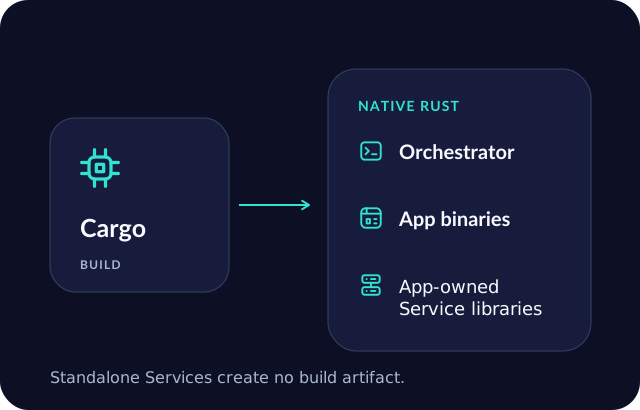
For main.l, successful publication yields:
mainmain.apps/ .l-owner generations/ <generation-id>/ manifest.json app-000The version-1 manifest lists App binaries under apps. App-constructed Service libraries are build dependencies, not executable companions; standalone Service declarations add no packages.
Builds privately compile and validate all artifacts before publishing an immutable companion generation and atomically replacing the orchestrator. Failures preserve working output; old generations remain for running programs. Unrelated outputs and symlinked companion/generation directories are rejected.
Move the executable and its .apps directory together: it finds companions relative to itself. The source filename stem determines the output basename. The publication contract covers failure and concurrent-build details.
Streams and statuses
Section titled “Streams and statuses”| Status | Boundary |
|---|---|
| 0 | Help, version output, or a successful native build. |
| 2 | Invalid invocation or unsupported host. |
| 1 | Resolution, asset initialization, compilation, generation, Cargo, publication, or output-write failure. |
Successful builds print only the absolute executable path and a newline; diagnostics go to stderr. Building never runs source instructions, Apps or deployment scripts. The separately invoked program owns its status and stdout.
Verification witnesses
Section titled “Verification witnesses”Version tests check exact output and invalid combinations; command tests cover help, defaults, option order and resource diagnostics. Publication tests cover preserved prior outputs, matched concurrent generations and unrelated destinations. Cargo identity tests inspect genuine native artifact identity.
Canonical source: docs/cli/build.md.